
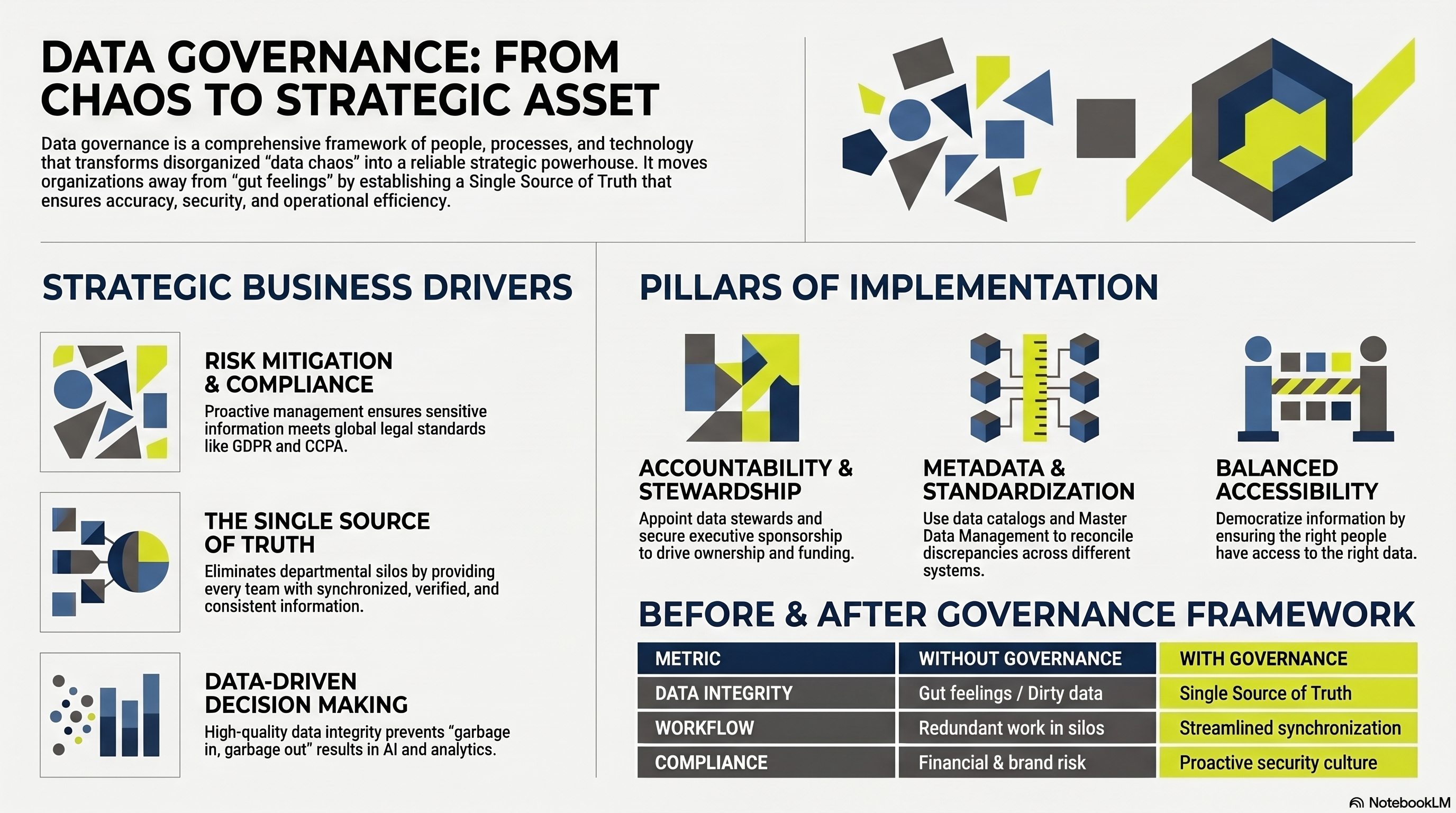
Establishing a comprehensive data governance framework and a cohesive data strategy is no longer a luxury for modern enterprises; it is a fundamental requirement for survival in a digital economy. Without these structures, data remains a chaotic collection of bits and bytes scattered across various departments, often leading to conflicting insights and operational friction. A well-defined strategy acts as a North Star, aligning technological investments with business objectives, while a governance framework provides the rules of engagement. Together, they ensure that every piece of information generated or consumed by the company serves a specific, valuable purpose rather than becoming a liability.
One of the most immediate benefits of this implementation is the drastic improvement in data quality and reliability. In many companies lacking oversight, employees often encounter “dirty data” information that is duplicated, outdated, or formatted inconsistently. This leads to a lack of trust in internal reporting, where different teams might present different versions of the same metric. By implementing governance standards, an organization creates a “Single Source of Truth,” ensuring that decision-makers are working with accurate, high-fidelity information. This reliability is the bedrock upon which successful business intelligence and advanced analytics are built.
Risk management and regulatory compliance form another critical pillar of the governance argument. In an era of strict privacy laws like GDPR and CCPA, the mishandling of customer data can lead to staggering financial penalties and irreparable brand damage. A robust governance framework identifies sensitive data assets and enforces strict access controls and retention policies. It moves the company from a reactive stance scrambling to fix leaks or audit findings to a proactive posture where security and privacy are baked into the data lifecycle by design. This protection extends to the company’s intellectual property, safeguarding the secrets that provide a competitive edge.
Beyond mere protection, a solid data strategy acts as a catalyst for operational efficiency and cost reduction. Companies often waste significant resources on redundant storage and manual data reconciliation tasks that could be automated. By streamlining how data flows between systems and departments, organizations can eliminate silos and reduce the “data tax” that employees pay when they spend hours searching for or cleaning information. This efficiency allows the workforce to shift their focus from administrative maintenance to high-value activities, such as identifying new market trends or optimizing customer experiences.
Furthermore, the implementation of these frameworks is the only viable path toward successful scaling and the adoption of emerging technologies like Artificial Intelligence. AI and machine learning models are notoriously sensitive to the quality of the data they are trained on; poor governance inevitably leads to biased or incorrect outputs. A forward-looking data strategy ensures that the infrastructure is scalable and that the data is “AI-ready.” By organizing data today, companies pave the way for a future where they can seamlessly integrate new tools and maintain a competitive pace in a rapidly evolving technological landscape.
Finally, the true value of data governance and strategy lies in the shift toward a data-driven culture. When an organization treats data as a strategic asset rather than a byproduct of IT, it empowers employees at every level to make evidence-based decisions. This cultural shift fosters innovation, as teams can experiment with confidence knowing they have the tools to measure results accurately. Ultimately, companies that master their data are more agile, more resilient to market shifts, and better equipped to provide personalized value to their customers, turning their information into a permanent engine for growth.

