In the modern enterprise, information is the most valuable asset. However, as companies rush to adopt Large Language Models (LLMs) to manage their internal knowledge, they often face a “security-first” dilemma: How do we use AI’s reasoning power without compromising our proprietary data?
The answer lies in Offline Retrieval-Augmented Generation (RAG) a private, secure, and hyper-accurate architecture that keeps your intelligence in-house.
The Problem: The Vulnerability of Cloud AI
Standard cloud-based AI tools operate on a “send-and-receive” model. Every time an employee asks a question, sensitive data travels over the public internet to a third-party server. This creates three primary risks:
Data Leakage: Proprietary secrets can inadvertently be used to train future iterations of public models.
Compliance Failures: Regulations like GDPR, HIPAA, or SOC2 often strictly forbid sending sensitive data to external AI providers.
Shadow AI: Without a secure internal alternative, employees will use public tools, creating “pockets” of unmanaged corporate data in the cloud.
The Solution: What is Offline RAG?
RAG (Retrieval-Augmented Generation) is a technique that gives an LLM access to a specific “library” of your company’s documents. Instead of relying on its general training data, the AI “looks up” the answer in your provided files before responding.
By moving this process Offline, you host both the “Brain” (the LLM) and the “Library” (your database) on your own local servers or private cloud.
How the Offline Architecture Works:
1.Data Ingestion: Your documents (PDFs, Wikis, Code) are converted into mathematical vectors and stored in a local Vector Database.
2. The Query: An employee asks a question.
3. The Retrieval: The system finds the most relevant “snippets” from your local database.
4. The Generation: An Offline LLM (like Llama 3 or Mistral) processes those snippets and generates an answer, all without an internet connection.
Key Advantages for the Enterprise
Feature
Cloud-Based AI
Offline RAG
Data Privacy
Risk of third-party exposure
100% Data Sovereignty
Accuracy
High risk of “hallucinations”
Grounded in your specific facts
Cost
Monthly subscriptions & API fees
One-time hardware/setup costs (On-Prem)
Connectivity
Requires stable internet
Works in “Air-Gapped” environments
Security
Shared infrastructure
Isolated, private infrastructure
Strategic Benefits
1. Zero-Trust Security With an offline model, your “attack surface” is virtually eliminated. Because the model doesn’t communicate with the outside world, your R&D, legal strategies, and customer data remain behind your corporate firewall.
2. Eliminate “Hallucinations” Generic AI often “guesses” when it doesn’t know the answer. RAG forces the model to cite its sources. If the answer isn’t in your documents, the AI will simply say “I don’t know,” rather than making up a plausible lie.
3. Deep Domain Expertise A public AI doesn’t know your 2024 updated safety protocols or your specific software architecture. Offline RAG turns your AI into a specialist that has “read” every single document your company has ever produced.
4. Long-Term Cost Efficiency While cloud APIs seem cheap initially, costs scale aggressively with usage. An offline setup involves an initial investment in hardware (GPUs) or private cloud instances, but once running, the cost per query is near zero.
Privacy-First AI: Scaling Offline RAG with vLLM and Python
The biggest barrier to Enterprise AI isn’t the technology, it’s Data Sovereignty. Sending proprietary R&D, legal contracts, or customer data to a black-box cloud API is a non-starter for regulated industries.
The solution is an Offline RAG (Retrieval-Augmented Generation) architecture. By hosting your own LLM, you ensure that your data never leaves your internal network.
The Engine: Why vLLM?
To make an offline model viable, it must be fast. We recommend using vLLM, a high-throughput serving engine that allows you to:
Maximize GPU Utilization: Use PagedAttention to handle more concurrent requests.
OpenAI Compatibility: vLLM mimics the OpenAI API structure, making it a “drop-in” replacement for your existing Python code.
Quantization Support: Run massive models (like Llama 3 70B) on consumer-grade or mid-range enterprise GPUs using AWQ or FP8.
The Technical Stack: 3 Steps to Private Intelligence
1. Spin up the Inference Server Instead of complex boilerplate, vLLM allows you to expose a model with a single command.
2. The Python RAG Logic Once the server is live, your internal Python application can query it securely. Here is how you integrate your local “Brain” with your local “Library”:
import openai
from sentence_transformers import SentenceTransformer

# 1. Connect to your LOCAL vLLM server
client = openai.OpenAI(
    base_url="http://localhost:8000/v1",
    api_key="internal-only-secret"
)

# 2. Basic RAG Flow
def ask_internal_ai(user_query, retrieved_context):
    response = client.chat.completions.create(
        model="meta-llama/Meta-Llama-3-8B-Instruct",
        messages=[
            {"role": "system", "content": "You are a secure internal assistant. Use ONLY the provided context."},
            {"role": "user", "content": f"Context: {retrieved_context}\n\nQuestion: {user_query}"}
        ]
    )
    return response.choices[0].message.content

# Example usage with local data
context = "Project X release date is October 2026. Budget is $2M."
print(ask_internal_ai("When is Project X launching?", context))
3. Vector Database (The Library) To complete the offline setup, pair the above with an on-prem vector store like ChromaDB, Qdrant, or Milvus. This ensures the retrieval step is just as private as the generation step.
Why This Wins for the Enterprise:
Zero Latency Spikes: No internet-dependent fluctuations.
Cost Efficiency: No token costs. Scale to millions of queries for the price of electricity.
Full Control: Customize your system prompts and safety layers without third-party filters
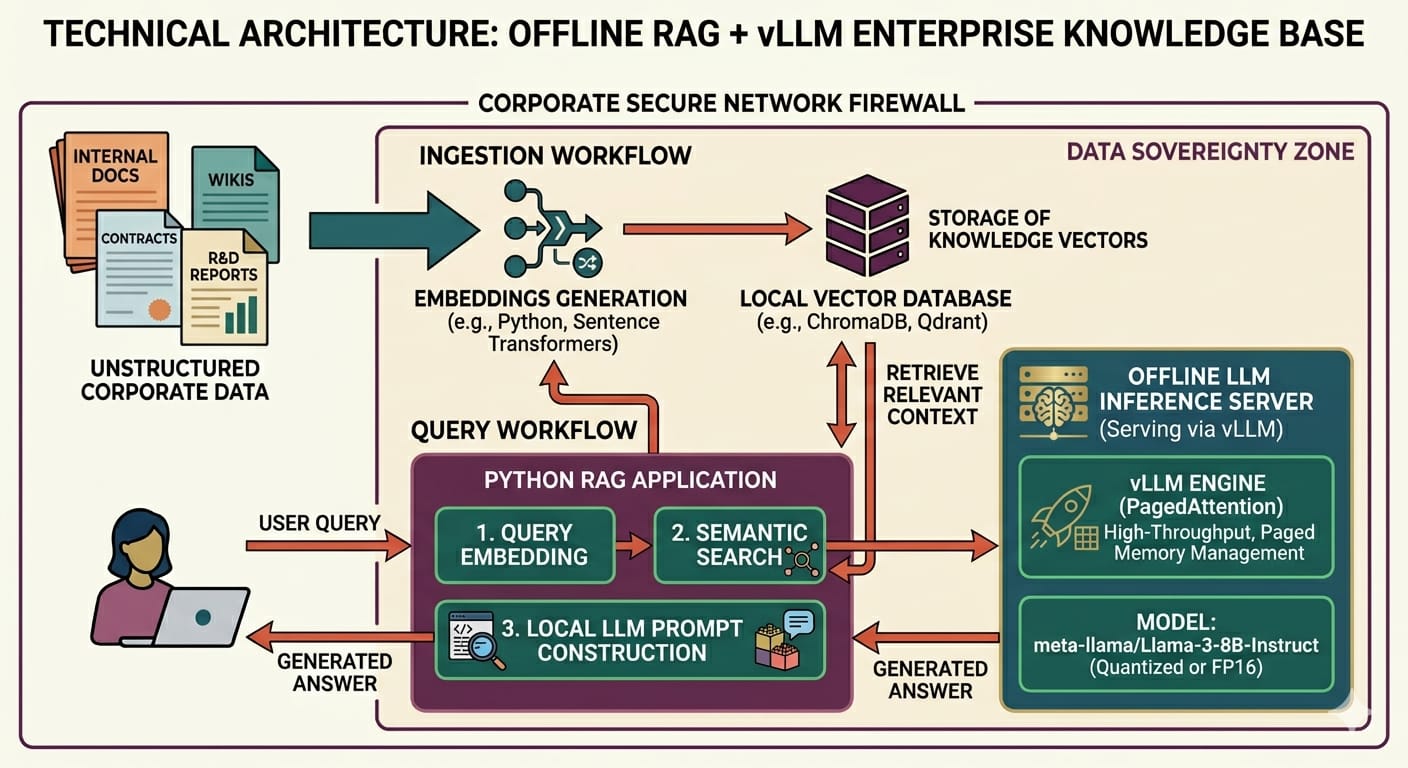
This technical diagram illustrates a secure, Offline Retrieval-Augmented Generation (RAG) architecture for enterprise knowledge bases.
It is divided into two main processes, both entirely enclosed within a Corporate Secure Network Firewall (the “Data Sovereignty Zone”):
1.Ingestion Workflow (Top): Shows how unstructured corporate data (Internal Docs, Wikis, R&D Reports) is processed. It undergoes Embeddings Generation (using Python and Sentence Transformers) and is indexed in a Local Vector Database (like ChromaDB or Qdrant) for fast semantic search.
2.Query Workflow (Bottom): Detail how a user’s question is handled:
The Python RAG Application orchestrates the process: it converts the query into an embedding, performs a Semantic Search to “retrieve relevant context” from the local database, and constructs a precise prompt.
This prompt is sent to an Offline LLM Inference Server, which serves a powerful, open-source model (like Llama 3) using the vLLM Engine. The diagram specifically highlights vLLM’s PagedAttention for high-throughput, efficient memory management.
A securely generated answer is then returned to the user without any data ever leaving the private network.
Is Your Company Ready for Private AI?
Transitioning to an offline knowledge base is no longer a luxury, it’s a necessity for any organization that values its intellectual property. Whether you are in healthcare, finance, or high-tech manufacturing, the goal is the same: Intelligence without exposure.
The Future is Private. Stop sending your data to the cloud and start building your own internal “Corporate Brain” today.